
PVBLIC and World Food Programme Host Executive Briefing on Food Mobilisation and Response to Crises
29 July 2026

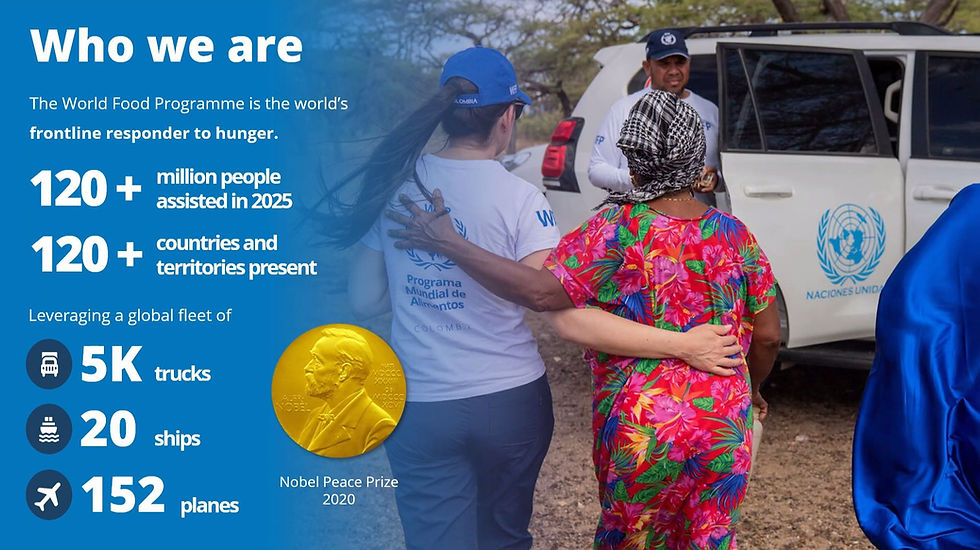
Global food security is increasingly affected by interconnected shocks, including conflict, disease outbreaks, climate extremes and disruptions to trade and transport networks. These crises are increasing humanitarian needs while placing additional pressure on food systems, supply chains, markets and vulnerable communities. WFP currently operates in more than 120 countries and territories and requires significant resources and partnerships to respond effectively to rising needs.
Recent developments - including escalating tensions affecting regional trade and transport routes in the Middle East, the Ebola outbreak in Central and East Africa, and other emergencies such as Venezuela - highlight the importance of preparedness, operational flexibility and rapid financing. These events demonstrate how localized emergencies can quickly generate wider food security, economic and humanitarian impacts across regions.
As food security challenges become increasingly interconnected, partnerships across sectors are more important than ever. It was against this background that in 2025, PVBLIC Foundation signed a signed Memorandum of Understanding with the World Food Programme (WFP) at the 80th session of the United Nations General Assembly to establish a partnership that amplifies the important work of this UN agency to end hunger. Building on the MoU, PVBLIC and the WFP convened an executive briefing for family offices, philanthropists, private sector leaders, and social impact advocates from around the world to explore solutions for these challenges through cross-sector collaboration.

The briefing examined how family offices, philanthropists, and businesses can contribute capital, logistics capacity, technology and data to help the World Food Programme respond earlier and more effectively to crises.
In his opening remarks, Sergio Fernández de Córdova, Executive Chairman of PVBLIC Foundation explained "The future of humanitarian response will depend not only on public resources, but how effectively we mobilize private leadership, innovation, and partnerships" He further highlighted “All the resources are there. The money is there, the capital, the resource, technology, the infrastructure, and really what we need is the right stakeholders coming together and to implement.”
Ending Hunger: A collective mission
Opening the discussion, Virginia Villar Arribas, Director, Private Sector Partnerships Service, at the World Food Programme, called on participants to rethink the narrative around hunger.
“I wanted to start with the simple truth. Hunger can be ended. Not reduced, not managed; hunger can actually be ended. And I know that sounds ambitious, but it isn’t a dream,” she explained, highlighting the important work that the organization does.” And we can do it together. Each one of us can make a difference”.
WFP works on the ground through its operations in more than 120 countries and territories. To make this important goal a reality, WFP works with hundreds of partners at the local, national and international levels. to make ending hunger a reality and to prove every day that it is possible.
The organization’s Chief of the Programme & Support Unit - Emergency Preparedness and Response, Ana Fernandez, outlined the vast network of humanitarians who are ready to support across all avenues of response, from operations and information sharing, to accessibility, nutrition, and aid. WFP has over 18,000 colleagues across regions who can be deployed within a few hours to prepare the most effective response for countries in the face of adversity and serve populations. “The sooner we can respond, the more lives we can save, and the quicker populations will recover," she said.
Data and Logistics: The tools to save lives
The discussion highlighted how food insecurity today is driven by overlapping crises, from conflict and displacement to disease outbreaks, extreme weather, and disruptions to global trade. This requires coordinated, unified action rather than isolated interventions, especially around data, logistics, infrastructure, and systems.
Jean-Martin Bauer, Director of Food Security and Nutrition Analysis Service, presented WFP's Hunger Map Live platform, a key data tool that helps humanitarian agencies gain insights, anticipate crises, prioritize resources, and respond before conditions deteriorate further.
“Data is the very lifeblood of this agency,” he explained. “We're good at it, and we're quite keen on sharing the data that we have and the knowledge we acquire with other actors.”

From Dialogue to Action and Impact
It is apparent how localized emergencies can quickly generate wider food security, economic and humanitarian impacts across regions. WFP requires significant resources and partnerships, as well as cross-sector coordination to respond effectively to rising needs, from the Middle East, Central and East Africa, to South America. That is why we need partners to rise to the occasion and invest today and in the future.
Laurence Kalinsky, Executive Director of Family Offices for Sustainable Development (FOSD), reflected on the role collaborative partnerships can play in strengthening humanitarian response. "Effective response requires more than funding alone. It requires preparedness, logistics, data, technology, and most importantly, partnerships," he shared. "PVBLIC's role is to help move this conversation from education to engagement, and then ultimately activation."
The briefing demonstrated the power of multi-stakeholder engagements and pathways for a more interconnected response that focuses on short-term needs and long-term resilience. PVBLIC Foundation is committed to help build the partnerships that multilateral institutions increasingly require, bringing together governments,multilateral institutions, philanthropy, family offices, the private sector, and technology, as Executive Chairman, Sergio Fernández de Cordova, stated.
For additional information about partnering with PVBLIC Foundation or to explore future collaboration opportunities, fill out this engagement form.
Resources from World Food Programme:
WFP DataViz Platform: dataviz.vam.wfp.org
WFP HungerMap LIVE: hungermap.wfp.org/food?w=ipc-phase-3&m=percentage
Publications:


Starting a run is incredibly straightforward. Once your sled begins moving, guide it down the mountain and keep it away from anything Snow Rider that could bring your journey to an immediate end.