
SDG Data Alliance Strengthens Regional Geospatial Leadership at GeoGov Middle East Summit
- pvblic
- Nov 20, 2025
- 2 min read

From October 27 to 30, Abu Dhabi became a global hub for dialogue on the future of geospatial governance and data-driven development during the GeoGov Middle East Summit 2025, convened by Geospatial World.
Building on the momentum from the 80th Session of the UN General Assembly, where the SDG Data Alliance and Geospatial World formalized a new Implementing Partnership Agreement, the Summit provided an opportunity to advance the data needs of developing countries, including through the Antigua and Barbuda Agenda for SIDS (ABAS), and supporting developing nations in leveraging geospatial innovation and technology for resilient prosperity.
The SDG Data Alliance, led by Executive Director Dr. Greg Scott, played a central role throughout the week’s activities, beginning with the Geospatial Knowledge Infrastructure (GKI) Training Program held on October 27–28. As an official partner of the program, the Alliance opened the sessions and led discussions on how GKI can directly contribute to sustainable development outcomes and social impact. The training gathered regional agencies and experts to explore how countries can transition from traditional spatial data systems to fully integrated, real-time Geospatial Knowledge Infrastructure, positioning geospatial intelligence as a driver of innovation, policy, and resilience.
Following the training, the SDG Data Alliance took part in the GeoGov Middle East Summit on October 29–30, under the theme “Geospatial Infrastructure: Advancing the National and Regional Geospatial Ecosystem.” During Plenary Session 1, Dr. Greg Scott emphasized the importance of embedding geospatial governance into national strategies to unlock cross-sectoral benefits across the economy, environment, and society.

Image: Dr. Greg Scott, Executive Director of the SDG Data Alliance, during the GeoGov Middle East Summit in Abu Dhabi.
He also moderated two high-level sessions: “Spatial Data Infrastructure to Geospatial Knowledge Infrastructure: Value Impact for Economy, Society, and Environment” and “GKI-enabled Open Data and Real-Time Geospatial Intelligence.” These discussions underscored how open data, interoperability, and innovation frameworks can accelerate national digital transformation and regional collaboration across the Middle East.
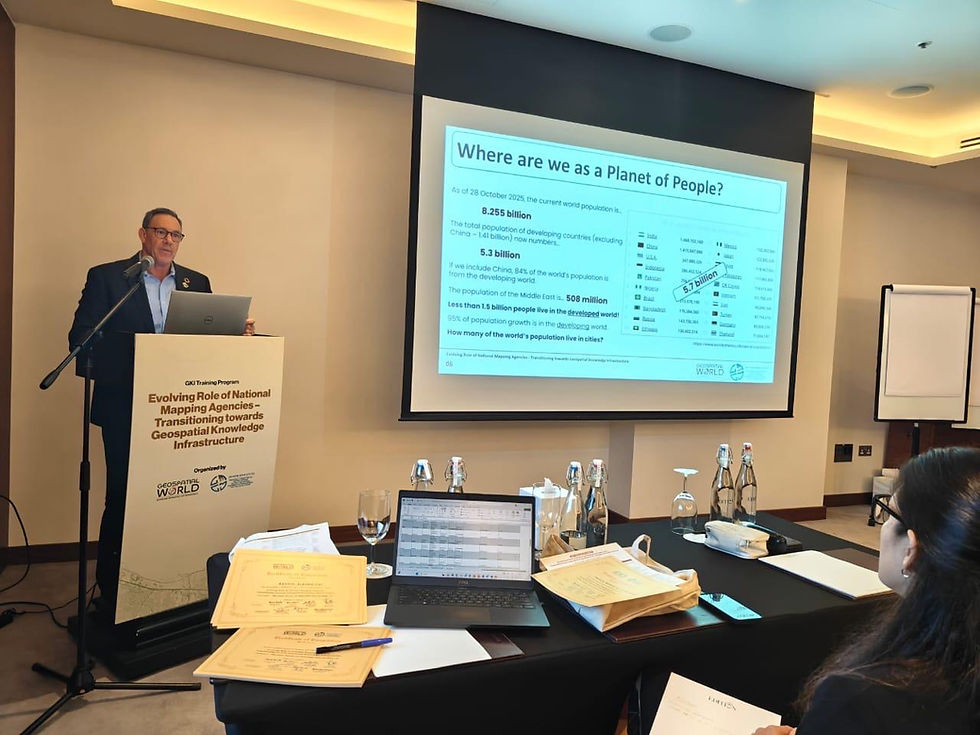
Image: Dr. Greg Scott, Executive Director of the SDG Data Alliance, during the GKI Training Program in Abu Dhabi.

Image: GKI Training Program guests. Photo credit: PVBLIC Foundation.
Through its active engagement at the GeoGov Middle East Summit, the SDG Data Alliance reinforced its commitment to advancing geospatial knowledge as a cornerstone of sustainable development, empowering countries to turn data into decisions, and infrastructure into impact.


Comments