
From Dialogue to Design: Inside the Transforming Global Education Summit at the United Nations
- pvblic
- 1 day ago
- 9 min read
1 May 2026 | United Nations Headquarters, New York

On 1 May, 2026, the ECOSOC Chamber at United Nations Headquarters in New York became the setting for the Transforming Global Education Summit. Convened by PVBLIC Foundation, in collaboration with the Government of Antigua and Barbuda, the Kingdom of Tonga, and the Learning Economy Foundation, and supported by 256 Network and the UnitEd Youth Council, the Transforming Global Education Summit brought together government leaders and ministers, UN entities, multilateral changemakers, technologists, educators, investors, and youth representatives from across the globe under one shared conviction: education can no longer be treated as a standalone service.
The theme of the day was Redefining Education as Global Infrastructure, and every session built toward a single imperative: the time has arrived to move from dialogue to design, and from design to delivery.
Opening the Room: A Call to Action

Kerry Bannigan, President of the Board of PVBLIC Foundation, delivered the opening remarks on behalf of the organization and Executive Chairman Sergio Fernández de Córdova. Her words set the tone for the dialogues that followed.
"Education is no longer a standalone actor," she said. "It is a core national infrastructure. It determines economic resilience, workforce readiness, and a country's ability to compete and adapt."
The questions she posed would anchor conversations throughout the day: How can education systems better reflect national development priorities? How can technology expand access while maintaining equity? And how do we ensure that the countries facing the greatest constraints are fully included in the solutions being built?

Maher Nasser, Director of the Outreach Division at the United Nations Department of Global Communications, underscored the transformative power of education. "History shows us that countries that invested heavily in education, at all levels, have overcome poverty," he said. Highlighting both global evidence and personal experience, he emphasized education as a critical pathway to resilience and opportunity. He also pointed to the scale of today’s challenge, with 272 million children and youth out of school and declining learning outcomes worldwide, particularly affecting women. Referencing recent UN frameworks, including the Pact for the Future and the Global Digital Compact, Nasser reinforced the role of education and digital infrastructure as central drivers of sustainable development.
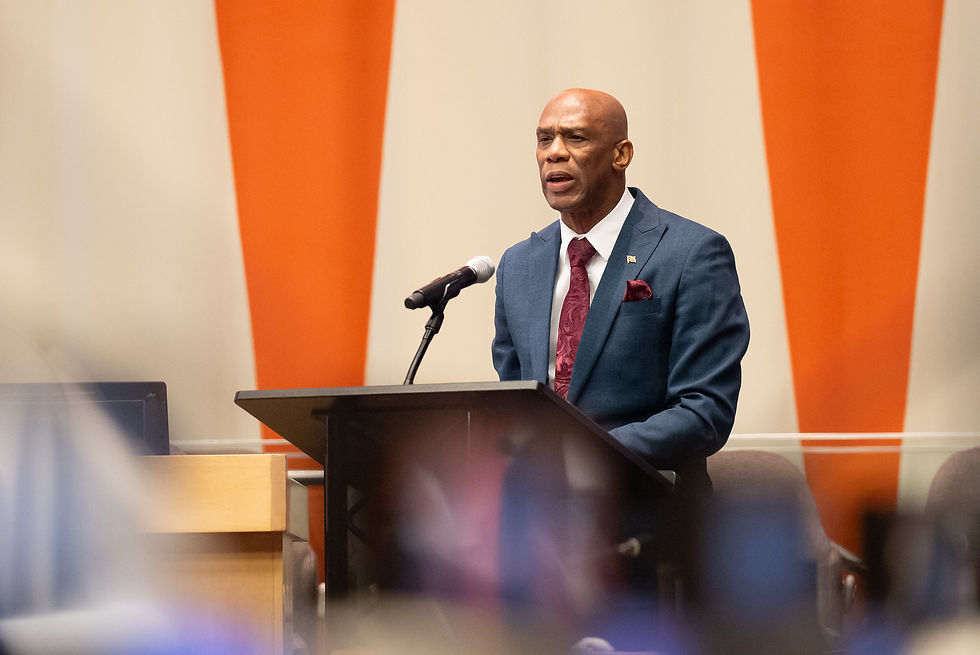
Before the panels began, representatives from the co-host governments grounded the discussion in the lived realities of Small Island Developing States (SIDS), where education systems operate under conditions far beyond the assumptions of most policy frameworks. Honourable Dr. Mo'ale 'Otunuku, Minister of Education and Training of the Kingdom of Tonga, emphasized the urgency and personal stakes: "For Tonga, education is not an abstract issue. It is personal. It is national. It is generational." In a context shaped by geographic isolation and recurring disruptions, he underscored a clear commitment: "Every child on every island must be able to learn, to be safe, to be supported and to be prepared for the future."
Clare L. Browne of Antigua and Barbuda reinforced the need to rethink education’s role entirely, stating that "education must now be understood as core national infrastructure: fundamental to resilience, economic performance, social stability, and national development." She highlighted the importance of precision investment, strong country-led partnerships, and systems-focused innovation, emphasizing that "technology must strengthen public systems, not bypass them," and that "every learner, regardless of circumstance, should benefit from systems that are inclusive, responsive and future-ready."

A Day of Dialogue Advancing System Design
Across more than a dozen sessions, the Summit wove together a set of themes that kept returning, from system design and financing to the most vulnerable learners and the role of the multilateral community.
The morning opened with a fundamental challenge to how education has long been framed. Panelists in the Reframing Education as Infrastructure session, moderated by Dr. Steven Azeka of the Mozilla Foundation, questioned what is lost when education is treated purely as a service. Simone Ravaioli of Instructure argued that the current ecosystem is over-indexing on formal recognition of formal learning, and that the cost of that bias falls hardest on indigenous knowledge systems and informal learners. "If the last 20 years have been about lifelong learning," he said, "the next 20 years will be about lifelong recognition." Melanie Dukes of LearnerStudio pushed the framing further still: the real infrastructure question is not how we deliver knowledge, but how we develop humans across contexts, across their entire lives.

One of the day's most striking moments came from Dr. Dan Brenner, Executive Director of the United Nations International School (UNIS), who presented a case study that turned an idea into undeniable results. Through a partnership with a Nigerian NGO, UNIS launched a pilot program for 100 girls, many of whom had never opened a laptop. Ninety-six passed and received their GED. Forty were mothers who graduated alongside their children. The program has since expanded to a second cohort and is piloting Funky AI, a self-directed learning tool built with the students themselves. "They are dreaming about being doctors, lawyers, nurses, designers," Brenner told the room. "That hope never was in their lives before."
The SIDS session, moderated by Roland Mollerus of UN OHRLLS, reframed small island developing states not as peripheral cases but as incubators of practical innovation. After the 2022 Hunga Tonga volcanic eruption and tsunami affected 66% of students nationally, Tonga deployed radio, television, e-learning platforms, and community-based systems to keep more than 22,000 learners connected. Clare Browne of Antigua and Barbuda drew a sharp lesson from that experience: "Transformation does not begin with scale. It begins with coherence." And Ashaki Goodwin of PVBLIC Foundation named the real barrier plainly: too often, international support funds pilots, not programs, leaving stretched ministries to close the gap.

Midway through the day, the Summit paused for one of its most resonant moments. Representatives of the UnitEd Youth Council, Scouts, and students delivered a Youth Declaration — neither ceremonial nor abstract. "Where a child is born still shapes what they can learn and what opportunities they will have," said one delegate. "That should not be the case." They called for technology that closes gaps rather than widens them, for systems designed with young people rather than handed down to them, and for accountability that follows ambition: "What starts here does not stay here, not in theory, nor in reports, but in classrooms, in communities, and across countries."
The afternoon sessions expanded the conversation outward. A panel on building the human infrastructure for new education systems surfaced the often-overlooked preconditions for learning: Dr. Laura Bakosh of Inner Explorer argued that with 1 in 7 children experiencing a mental health disorder, a stressed brain is a blocked brain, and that daily mindfulness practice, embeddable in every classroom, is a biological intervention as much as a pedagogical one. Kumu Ramsay Taum of the Royal House of Hawaii challenged the room to stop measuring accounting and start measuring accountability, to design education systems that serve communities rather than extract from them.
The panel on Education and the Most Vulnerable, moderated by Kerry Bannigan, brought some of the Summit's most direct testimony. His Excellency Tapugao Falefou, Ambassador and Permanent Representative of Tuvalu to the United Nations, described the existential stakes for a nation where schools flood during king tides, outer island facilities lose power to storms, and sea levels have risen 15 centimeters in 50 years. "For Tuvalu, education cannot be separated from our national survival." Chaitanya Raj Singh Jaisalmer, Chairman of the Citta India Foundation, spoke of a school on the India-Pakistan border that runs a camel library to reach girls in villages too small for a building, a reminder that infrastructure, at its most essential, means reaching the unreachable.

From the UN system itself, voices aligned around a shared accountability. Anne-Claire Grossias of the UN Office for Outer Space Affairs made the case for satellite connectivity as education infrastructure, the only viable solution for one-third of the world's schoolchildren who cannot access remote learning from rural areas. Ola Goransson of UN DESA argued that the real test of intergovernmental leadership is not whether systems expand, but "whether they do so fairly and reach those furthest behind." And Nina Brandt of the UN Youth Office pressed the distinction between inviting young people into the room and actually letting them shape what happens there: "It's not only about opening the door. It's about leaving the door open."

The closing panel on Capital and Curriculum surfaced what often goes unsaid: the gap between who builds education systems and who finances them. Pinar Ozcan of Oxford's Saïd Business School observed that while more women, immigrants, and underrepresented founders are stepping into roles as builders, the money has not followed. Beth Bray of the Walton Family Foundation called on philanthropy to do more than fund research, to translate it into tools that teachers and communities can actually use. And Gabi Leibowitz of ElevenLabs offered a quiet provocation: when her company gave people who had lost their voices a voice that was truly their own, they didn't just get their needs met, they re-entered their lives. "The individual voice is as important as the words that are coming out." In education, multimodality and multilingualism are not accommodations. They are design requirements.
Closing: From Summit to System
Chris Purifoy, CEO of the Learning Economy Foundation, closed the Summit's formal sessions with a provocation that distilled the day's urgency.
"We need to build motorways to transport the vulnerable to poverty alleviation, not just private driveways that accelerate education for the privileged," he said. The digital public infrastructure that makes the next phase of education possible, portable learning records, lifelong learning pathways, interoperable credentials is ready. The standards are proven. "What we need now are champions on the local and country levels who are ready to conduct localized research, understand the context, and implement lifelong learning passports and pathways from learning to work."

The final word belonged to His Excellency Viliami Va'inga Tōnē, who offered the closing remarks on behalf of the Kingdom of Tonga. He synthesized the day with precision.
"Education can no longer be treated as a narrow sector," he said. "Education is national infrastructure. It is human infrastructure. It is digital infrastructure. It is resilience infrastructure. It is cultural infrastructure."
He described the central challenge not as a shortage of ideas, but a shortage of connection. The systems thinking required to make ideas work, to design learning ecosystems that see every child, support every teacher, use data responsibly, protect continuity of learning, and that countries can own and sustain.
He called on the Summit to be a beginning, not an end. "Let us leave with stronger partnerships. Let us support solutions that countries can own. And let us remember the promise at the center of this work: every child, wherever they live, must have the chance to learn, to belong, and to build a future."
What Comes Next
The Transforming Global Education Summit was not a summit that ended when the chamber doors closed. Across its more than a dozen sessions, it produced something more durable than statements: a shared design vocabulary, a network of governments and partners aligned around country-led implementation, and a growing body of proof, from Nigeria to Tuvalu to the Caribbean to Hawaii, that education systems can be redesigned to reach every learner.
The opportunity is here. As the youth delegates said it themselves: what starts here does not stay here.
The Transforming Global Education Summit was organized by PVBLIC Foundation and co-hosted with the Government of Antigua and Barbuda and the Government of the Kingdom of Tonga, with the Learning Economy Foundation serving as Strategic Partner and with support from 256 Network and the United Youth Council. The Summit was held on May 1, 2026, at United Nations Headquarters in New York.
Stay connected on social media: @pvblicf | @learnonomy | PVBLIC Foundation on LinkedIn | Learning Economy Foundation on LinkedIn


Comments